Independent scientific circle · Origins in 2016

CHEM
SQUAD.

Ten years of talking chemistry.

We met around an organic chemistry bench in 2016, discussing extracts from myrrh and nutmeg and what it would take to identify their constituents. We kept meeting after the course ended. Ten years later, seven of us still gather weekly to argue over papers, discuss experiments and bring new questions from different laboratories.

Read how it began

Research documentary / Chem Squad & scientific community

The Laboratory We Carried With Us

A human history of independent scientific friendships and a student chemistry movement.

Watch the documentary ↗ · 02:00 · Early friendships, chemistry festivals and student organizing.

2016Where our shared research story began
SevenChemistry graduates in the circle
WeeklyConversations that keep science alive
01 / The beginning

Before the publications,
there was a laboratory.

In 2016, our organic chemistry conversations kept returning to myrrh and nutmeg. We wanted to understand how their constituents could be extracted and identified. The plants had long medicinal histories, but those histories could not tell us which compounds were present in a sample or whether an extract had biological activity.

We talked through the practical questions: solvent selection, separation, chromatography and the assays that would be needed before making a medicinal claim. Those discussions often continued after we had left the laboratory.

After graduation, we entered different research groups and professions. We continued sending each other papers, questioning methods and returning to ideas that had first come up in class.

We continued meeting after our original laboratory coursework, bringing new papers and research questions from the institutions and specialties we had entered.

01 / 2016

Organic chemistry lab

Early conversations around extracting and studying natural products, including myrrh and nutmeg, and questioning their potential medicinal significance.

02 / The years that followed

Beyond one laboratory

Our research took us into different institutions and specialties. The conversations continued after we left the same department.

03 / Today

The weekly conversation

We continue to gather to discuss papers, research questions and developing ideas for the pleasure of learning together. Some friendships remain scientific long after graduation.

02 / The people

Seven chemists.
Still curious.

We followed different paths after university, but the papers and experiment ideas kept circulating among us. When we meet, nobody has to explain why they still care about a chemistry problem.

Seven people have kept this conversation alive since 2016.
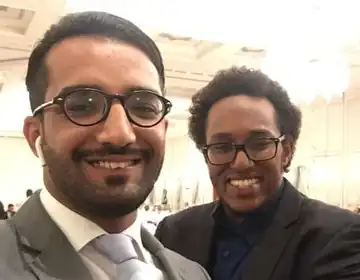
Mahmoud K. Al-Ruweidi and Khaled Jama Mohamoud together at a formal gatheringCS / 04

Khaled Jama
Mohamoud

Chem Squad · Member
CS / 06

Abdelgalil Khalaf
Ahmed

Chem Squad · Member
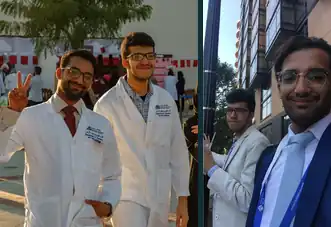
Two archival photographs of Ahmed Elgendy and Mahmoud Al-Ruweidi togetherCS / 07

Ahmed
Elgendy

Chem Squad · Member

From the photo archive

Photographs from our years together

Mohamed G. Nassr

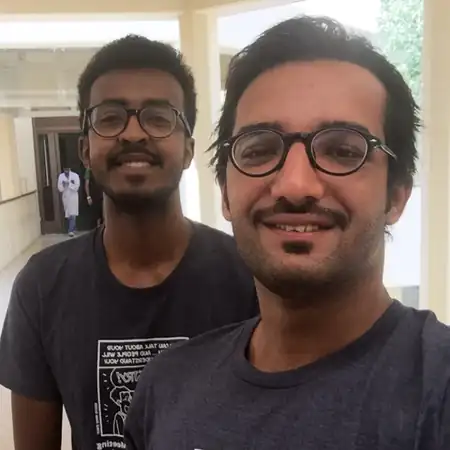
With Mahmoud K. Al-Ruweidi · Two photographs
Rakan Al-Zu'Bi

With Mahmoud K. Al-Ruweidi · Two photographs

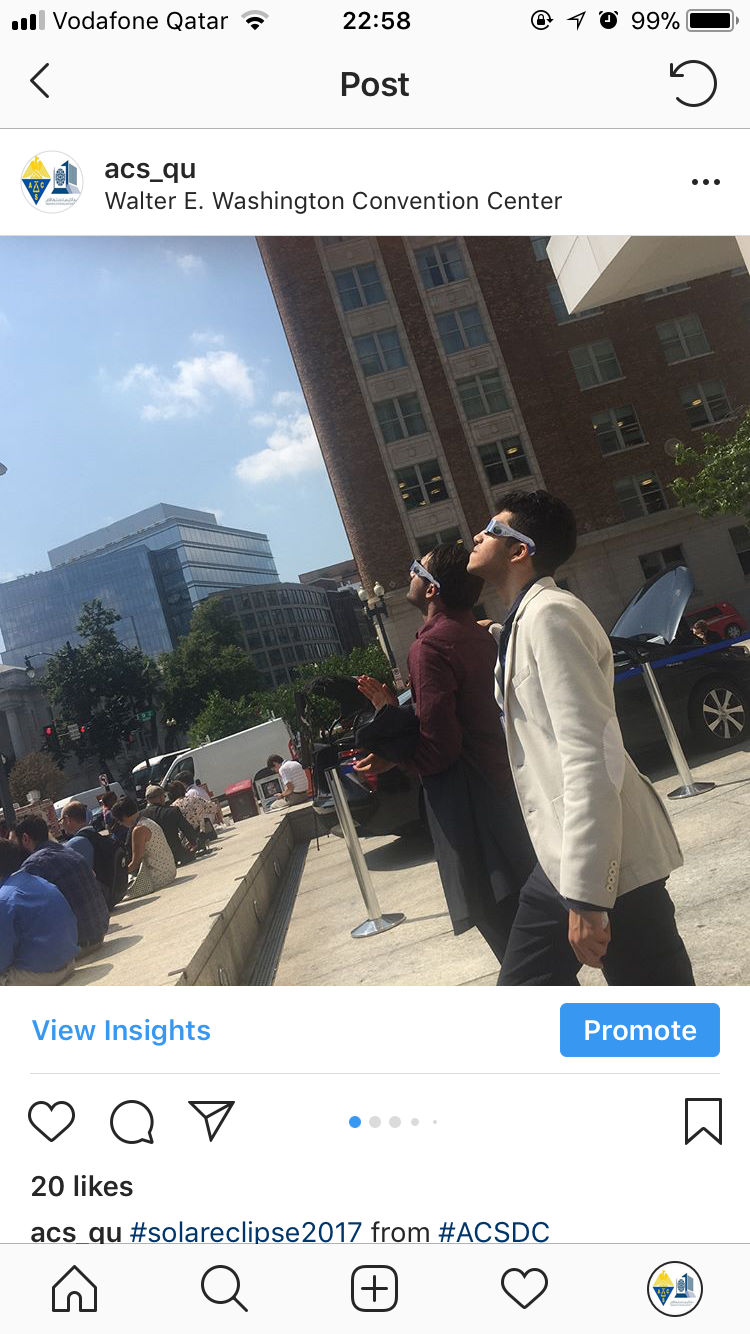
Mahmoud K. Al-Ruweidi and Ahmed Elgendy wearing solar-eclipse glasses in Washington, DC, in 2017
A moment from 2017 · Washington, DC

Between ACS sessions,
looking up.

Mahmoud K. Al-Ruweidi and Ahmed Elgendy watching the 2017 solar eclipse outside the Walter E. Washington Convention Center during the American Chemical Society visit. The image comes from an ACS Qatar University student chapter Instagram post. We stepped outside between the conference sessions to watch the eclipse.

ACS Qatar University student chapter · 2017
RESEARCH / WORK WE SHARED

The work we wrote together.

Some of us later met again on journal author lists, in book chapters and on conference programmes, even as our research moved into different laboratories. The work collected here involved at least two members of Chem Squad alongside the other researchers named in each publication or presentation.

Journal papers across our circle

Two published materials-science studies and one accepted historical article · 2020–2026

2020 / Surface and Coatings Technology / Published research

Antimicrobial modification of PLA scaffolds with ascorbic and fumaric acids via plasma treatment

Electrospun PLA fibre scaffolds, RF plasma activation, acid grafting, surface characterization and antimicrobial testing against S. aureus and E. coli. The research was undertaken with Anton Popelka and colleagues.

Chem Squad coauthors: Abdelrahman Adel Mahmoud, Mohamed G. Nassr, Mahmoud K. Al-Ruweidi, Khalid Jama Mohamoud. Additional named collaborators appear in the published author list.

Surface and Coatings Technology 400 (2020), 126216.

2021 / Polymers / Published research

Surface modification of poly(lactic acid) film via cold plasma-assisted grafting of fumaric and ascorbic acid

Plasma-initiated chemical modification of PLA film and its effects on surface properties and adhesion. This paper also involved Anton Popelka, Peter Kasák, Asma Abdulkareem and other collaborators.

Chem Squad coauthors: Mohamed G. Nassr, Abdelrahman Adel Mahmoud, Mahmoud K. Al-Ruweidi, Khalid Jama Mohamoud.

Polymers 13 (2021), 3717. Full authorship and contribution declarations are available in the journal article.

2026 / History of Pharmacy and Pharmaceuticals / Accepted journal article · forthcoming

Making Medicines Keep: Syrups, Substitution, and Pharmaceutical Reliability in Ayyubid-Mamluk Cairo

A historical study of pharmaceutical reliability, material substitution and the practical knowledge used to prepare and preserve medicines in Ayyubid–Mamluk Cairo. Accepted for publication in 2026; final issue details, pages and DOI are not yet confirmed.

Chem Squad coauthors (3): Mahmoud K. Al-Ruweidi, Mohamed G. Nassr and Rakan Al-Zu'Bi.

History of Pharmacy and Pharmaceuticals · accepted manuscript (2026), not yet published.

Book chapters written together

Three chapters with at least two Chem Squad coauthors · published and accepted/forthcoming · 2026

2026 / Pharmaceutical modeling / Book chapter

Simulation of Drug Release and Performance Prediction Using Virtual Models

A critical examination of empirical and mechanistic release models, in vitro–in vivo translation, physiologically based modeling and uncertainty in formulation-performance predictions. A scholarly synthesis rather than a report of new experimental drug-release data.

Chem Squad coauthors (4): Mahmoud K. Al-Ruweidi, Rakan Al-Zu'Bi, Mohamed G. Nassr and Abdelrahman Adel Mahmoud.

Chapter 5 in Digital Twin Technology in Pharmaceutical Formulation and Smart Manufacturing (2026).

Forthcoming / Cubosomes in Oncology / Publisher-listed book chapter

Theranostic Potential of Cubosomes in Targeted Cancer Therapy: From Mechanistic Design to Clinical Translation

A critical review of cubosomal nanocarriers for cancer treatment and theranostics, from their mechanistic design and formulation characteristics to clinical translation. The publisher lists the chapter in its forthcoming volume; no publication date or completed publication is claimed.

Chem Squad coauthors (4): Mahmoud K. Al-Ruweidi, Rakan Al-Zu’bi, Abdelgalil Khalaf Ahmed and Mohamed G. Nassr (listed by the publisher as Mohammed Jaber Nasr). Additional credited coauthors: Doaa Elsayed Mahmoud and Abdelbary Elhissi.

Chapter 9 in Cubosomes in Oncology: Targeted Drug Delivery, Theranostics, and Clinical Applications · Apple Academic Press · publication date TBA.

2026 / Additive manufacturing & food materials / Accepted book chapter · forthcoming

Materials Science for 3D, 4D, 5D, and 6D Food Printing: Rheology, Microstructure, Smart Edible Inks, and Programmable Food Architecture

A scholarly chapter on rheological control, edible-ink formulation, microstructure and stimuli-responsive architectures in advanced food printing. The chapter is accepted/forthcoming; final publisher metadata and DOI are not yet confirmed.

Chem Squad coauthors (5): Mahmoud K. Al-Ruweidi, Abdelgalil Khalaf Ahmed, Rakan Al-Zu'Bi, Mohamed G. Nassr and Abdelrahman Adel Mahmoud. Additional credited coauthor: M. M. Bazed.

Works with overlapping authors

Across our author lists.

These publications were written by the authors named in each journal or book. They appear here because at least two members of Chem Squad worked on them, not because all seven participated or because Chem Squad was a research institution.

Alongside the journal articles and three jointly authored book chapters are early student manuscripts, conference posters and chapter presentations. Each source links to its own author list and publication status.

Posters, presentations & student writing

Documented work involving at least two members · 2016–2020

2016 / Early student literature review / Archival writing

A Literature Review on Trypsin Enzyme

An early literature review of trypsin's structure, catalytic activity and physiological functions by Ahmed Sedeek Elgendy and Mahmoud K. Al-Ruweidi. It is presented here as a shared student research manuscript, not as a peer-reviewed journal article or book chapter.

Authors: Ahmed Sedeek Elgendy and Mahmoud K. Al-Ruweidi.

2017 / Student literature-review poster / Archival record

A Literature Review Study on Indigo Dyes

An early coauthored review poster examining natural and synthetic indigo dyes, reduction to soluble leucoindigo and environmental considerations in dye processing. Included as documented student scholarship rather than a peer-reviewed journal publication.

Authors listed: Mahmoud K. Al-Ruweidi and Khaled Jama.

2020 / Qatar University Annual Research Forum and Exhibition

Development of PLA Fibers as an Antimicrobial Agent with Enhanced Infection Resistance Using Electrospinning/Plasma Technology

A conference abstract and poster on electrospun PLA scaffolds, plasma modification and their proposed use for infection-resistant biomaterial surfaces, preceding and accompanying the related peer-reviewed scaffold research.

Chem Squad contributors named: Abdelrahman Adel Mahmoud, Mohamed G. Nassr (listed as Mohammed Naser), Mahmoud K. Al-Ruweidi (listed as Mahmoud Abdelrasool), Khalid Jama Mohamoud.

2017 / ACS 254th National Meeting / Washington, DC

ACS Successful Students Chapter: ACS Qatar University as a Model

A conference presentation/poster explaining the establishment, outreach programme, student-led workshops, scientific excursions and research presentation ambitions of the Qatar University ACS Student Chapter.

Overlapping Chem Squad contributors: Mahmoud K. Al-Ruweidi and Ahmed Elgendy, with other ACS chapter contributors and academic advisers.

2018 / ACS 256th National Meeting

ACS Qatar University's Chapter: Updates on the Approach to Empower Young Chemists and Reach Out to Community

A conference poster documenting the chapter's continuing public science demonstrations, educational activities and programme of student involvement.

Overlapping Chem Squad contributors: Abdelrahman Adel Mahmoud, Ahmed Elgendy and Mahmoud K. Al-Ruweidi, together with other named QUACS contributors.

2015 onward / Student-led scientific community

The ACS Qatar University Student Chapter

Mahmoud helped found the chapter in 2015 and served as president; Ahmed Elgendy participated in its student leadership. The programme included Chem Talks, chemistry demonstrations and community outreach, instrumentation training for 29 students, field visits and opportunities for student participation in ACS national meetings.

This is part of the shared community history of some Chem Squad members, but QUACS is a distinct university student organization, not another name for Chem Squad.

Author-name variants in the original records

Conference and publisher records sometimes use different forms of the same author’s name, including Mahmoud Abdelrasool, Mohammed Naser and Khalid Jama. Mohamed G. Nassr (Nassr MG) and Mohammed Jaber Nasr (Nasr MJ) refer to the same Chem Squad member. Each citation retains the spelling used by its original source.

03 / A standing conversation

Once a week,
science has a seat.

The weekly gatherings are not conferences, compulsory seminars or a commercial programme. They are a place where scientists can talk without needing a deliverable before the conversation is worth having. A paper, a synthetic route, a strange result, or a speculative hypothesis can all be reasons to bring everyone together.

Independent thought benefits from company. The questions become sharper when someone else is willing to disagree, suggest an experiment, or expose an assumption that seemed obvious.

01

Bring a question.

Anything from reaction chemistry and natural products to a biomedical or pharmaceutical puzzle.

02

Follow the evidence.

Talk through mechanisms, methods, contradictory findings and the literature behind a claim.

03

Think beyond your own field.

One person's chemistry problem may connect to another's interest in biology, materials or therapeutic design.

04

Keep the conversation alive.

Not every discussion needs to become a publication. Sometimes the reward is a better understanding.

04 / From one subject to many

Our interests have
grown with us.

We trained in chemistry together, but our work has since taken different directions. The subjects below come from individual projects, independent collaborations and questions we still bring back to the group.

01 / Roots

Organic chemistry & natural products

Extraction, chemical identity, molecular transformation and the evaluation of proposed biological activity.

02 / Molecules

Medicinal & pharmaceutical chemistry

Structure–activity reasoning, therapeutic hypotheses, drug properties and design questions.

03 / Materials

Formulations & biomaterials

Carrier systems, polymer-based technologies and the relationship between material properties and performance.

04 / Evidence

Research papers & scientific writing

Literature evaluation, collaboration across projects and turning methods and ideas into carefully argued scholarship.

05 / Methods

Quantitative & computational thinking

How data analysis, modelling and experimental design can improve the interpretation of chemical and biomedical questions.

06 / People

Education & scientific exchange

Sharing knowledge, mentoring, communicating difficult ideas and making science a continuing conversation.

05 / Where the paths led

Separate careers.
A shared beginning.

From the same organic chemistry laboratory, we eventually followed different academic and professional paths. Five of the seven pursued master's-level study: four in Qatar and Ahmed Elgendy in Canada. Our interests expanded into fields including environmental science and solar-cell research, while education became another direction represented in the circle. The original foundation in chemistry remained, but the questions each person brought back grew more varied.

Someone might bring a chemistry problem to the table while another is thinking about biology or engineering. We still meet to exchange papers and challenge interpretations, drawing on the work each of us has pursued.

Some members of the circle are also among the founding members of Majales Education. That connection reflects how a long friendship in science can extend into educational entrepreneurship, while Chem Squad remains its own informal community.

Explore Mahmoud's educational initiatives
Still meeting after ten years

The conversation carried on after the laboratory course ended.

Someone brings a new paper. Someone else challenges its assumptions. An idea for an experiment moves around the room until we can see what would actually have to be measured.

Our work has taken us into different fields. We still come back to the same table.

CHEM SQUAD · SINCE 2016
How Chem Squad works

Chem Squad, since 2016.

Chem Squad began as a circle of chemistry students who continued meeting as graduates and researchers. We discuss ideas independently; experiments and papers belong to the researchers and institutions that carry them out. Our early interest in medicinal plants led to questions about composition and biological testing that still require appropriate experimental evidence.

The photographs and accounts here follow the group's early laboratory discussions, friendships and later meetings. Where a member has published research, the individual paper and its authors provide the scientific record.