Scientific computing / artificial intelligence / computational pharmaceutics

Computation is also a laboratory instrument.

My research combines experimental science with the computational methods needed to interpret measurements, interrogate biomedical images, and make formulation decisions more transparent.

I work across two distinct levels: peer-reviewed collaborative AI research on fetal echocardiography, and software and quantitative methods developed for pharmaceutical, imaging, and research-analysis workflows. These are related capabilities, but not interchangeable claims.

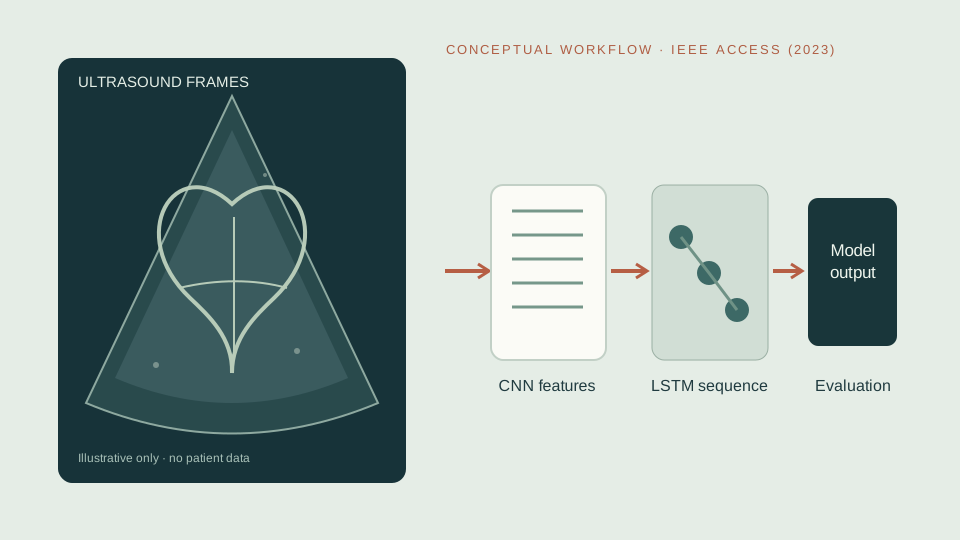
Conceptual fetal echocardiography frames leading to CNN feature extraction, an LSTM sequence model, and evaluated output
Original schematic of a published deep-learning methodology, not experimental echocardiogram data.

01 / Published artificial intelligence research

Fetal echocardiography.
Deep learning, clinically grounded.

In a 2023 IEEE Access pilot study, I shared first-authorship credit for work on detecting congenital heart disease from fetal echocardiograms using stacked CNN–LSTM models.

Peer-reviewed / Equal first contribution

From ultrasound sequences to interpretable evidence.

Rahman T, Al-Ruweidi MKAA, et al. IEEE Access (2023), 11:110375–110390. DOI: 10.1109/ACCESS.2023.3316719

Read original publication ↗

The study investigated a computer-vision approach to fetal congenital heart disease screening, with particular attention to hypoplastic left heart syndrome. The original paper reported a pilot cohort of 9 healthy and 13 HLHS cases; its modelling workflow compared MobileNetV2, ResNet18, ResNet50, DenseNet121 and GoogLeNet CNN–LSTM architectures and used a stacked model with cross-validation. This sample size limits generalisability, and the reported metrics must not be mistaken for external clinical validation.

My documented contribution includes ultrasound data curation and preprocessing, model evaluation, clinical interpretation, figures and manuscript development. I am recorded as an equal first author. The paper reports exploratory results from a pilot cohort; external validation and clinical deployment remain separate requirements.

Image preprocessingCNNLSTMModel stackingFetal echocardiographyEvaluation

02 / Open-source scientific software

Drug delivery design.
Transparent by construction.

NanoFormulationDesigner is a materials-aware preformulation workbench built around physicochemical descriptors and stated model assumptions. Its calculations are inspectable: which properties were used, which inference followed and what measurements would be needed to test it.

Open-source repository / Working software

NanoFormulationDesigner

Python package, Streamlit interface and command-line tools for screening nanocarrier compositions, route constraints, descriptor-supported formulation tendencies and laboratory design choices. The repository includes tests, data provenance documentation and a material-property database.

Explore the code and documentation ↗
Pharmaceutical modelling / Thesis-linked development

Formulation physics and descriptor calculations

Scientific Python workflows for HLB mixtures, critical packing parameter, Tanford chain geometry, Hansen solubility distance, Flory–Huggins interaction concepts and ionization calculations. These support experimental planning for vesicular systems, including the ongoing inhalable niosome/proniosome research.

Visit pulmonary formulation research ↗

What the software can show

Reproducible reasoning, not manufactured certainty.

The code makes calculations inspectable, warns about missing material parameters and provides explainable screening recommendations.

Molecular or material properties ↓ Physicochemical descriptors ↓ Formulation design checks ↓ Ranked tendencies + uncertainty ↓ Experimental screening plan

Repository boundary: descriptor-based decision support is not a validated predictor of encapsulation efficiency, particle size, stability, toxicity, biodistribution or clinical performance. The optional LLM text layer is not the source of physical constants.

03 / Quantitative research methods

Data processing changes what
an experiment can establish.

Bioimage analysis

High-speed zebrafish cardiac and vascular microscopy, imaging-derived physiological parameters, and quantitative use of ImageJ and MicroZebraLab. This work is grounded in coauthored publications on blood-flow hemodynamics and vascular-development biology.

Micron (2020) methodology ↗

Scientific data analysis

Python, NumPy and pandas for reproducible research calculations and data transformation; R, SQL and Tableau for tabular analysis, statistical reporting, querying and visualisation across research and professional analytics projects. These are documented applications, not claims that all were used in the echocardiography paper.

Research experience and data work ↗

Biomedical evidence

Clinical research data-quality workflows, cardiovascular biomarkers, gene-expression and pathway interpretation; structured environmental-exposure analysis involving EDI, HQ/HI and MOE/MOS frameworks. These are quantitative and evidence-synthesis roles, distinct from training or deploying a medical machine-learning system.

Academic CV and documented roles ↗

Reproducibility

Documented source provenance, validation thresholds, unit-tested scientific kernels, explicit uncertainty and numerical checks. I approach computational outputs as hypotheses or decision aids whose validity depends on underlying data and independent experimental verification.

Inspect the repository ↗

04 / Computing reflected in publications and chapters

Research outputs across the
computational spectrum.

2023 · Published original research · Co-first author

Deep learning for fetal echocardiograms

Stacking-based CNN–LSTM detection of congenital heart disease in a pilot study. The principal peer-reviewed record of my contribution to biomedical AI.

IEEE Access paper ↗
2026 · Book chapter recorded in revised CV

Simulation of Drug Release and Performance Prediction Using Virtual Models

Pharmaceutical modelling, computational release considerations, and virtual performance estimation. Published as Chapter 5 (starting p. 97) in Digital Twin Technology in Pharmaceutical Formulation and Smart Manufacturing, Deep Science Publishing, August 2026. The volume’s published table of contents identifies the four coauthors; the DOI refers to the edited book, not a separate chapter.

Read the edited volume (book DOI) ↗
2022 · Published book chapter

Sensor technologies for predicting heart failure

Coauthored Wiley chapter reviewing minimally invasive and non-invasive sensing for cardiovascular prediction. It is a diagnostics and sensing review, not evidence of building a machine-learning model.

Wiley chapter ↗
2020 · Published original research

Zebrafish blood-flow and cardiac-function assessment

High-speed video microscopy and quantitative physiological measurements: a bridge between raw biomedical imagery and derived cardiovascular parameters.

Micron article ↗
2022 · Published immunology review chapter

Artificial intelligence in gastrointestinal immunology

In Autoimmune Diseases of the GI Tract Part II, coauthors surveyed diagnostic methods, biomarkers and the literature on artificial intelligence in gastrointestinal autoimmune disease. That contribution is a literature review; no new diagnostic model was trained or validated for the chapter.

Read IntechOpen chapter ↗

For all journal articles, accepted chapters, immunology publications and the historical-pharmacy paper, visit the searchable publication bibliography ↗.

05 / Structure-based discovery · methodological direction

Drug design requires more
than a docking score.

Molecular docking, protein–ligand visualization, structure-based virtual screening, molecular dynamics, pharmacophore modeling, QSAR and ADMET prediction are useful only when tied to appropriately validated chemical and pharmacological questions. My first-author SLIT2–ROBO patent analysis evaluates therapeutic modalities and experimental enablement; it is not a claim that I personally conducted the docking or simulations described in related literature.

STRUCTURE / AFFINITY HYPOTHESES

Docking, MD & virtual screening

Protein and ligand preparation, binding-site selection, docking/search protocols, conformational sampling, pose interpretation and independent binding validation. Model score is distinct from measured affinity and biological effect.

View illustrated methodological dossier ↗
MOLECULAR PROPERTY / PHARMACOKINETICS

QSAR, pharmacophores & ADMET

Chemical features and descriptor models, applicability domains, absorption and exposure predictions, and the distinction between molecular developability and delivery to a disease-relevant tissue.

Explore methods and primary references ↗

Attribution: These are methods included in the research programme and methodological bibliography. Independently verified, personally conducted computational work remains detailed in the fetal echocardiography, modeling and polymer-thermodynamics records.

PROSPECTIVE METHODS / COMPUTATION CONNECTED TO EXPERIMENT

From molecular prediction to an executable synthesis.

A direction I want to develop combines disease-target prioritization, virtual ligand screening, biosynthetic precursor and enzyme-pathway discovery, computer-assisted chemical retrosynthesis, and reaction-condition prediction. The computational outputs would be tested through experimentally tractable routes, including flow synthesis or biocatalysis where appropriate, before automated biological screening informs the next design cycle. I am particularly interested in uncertainty-aware active learning and multi-objective optimization across biological performance and process feasibility.

Predicted binding scores, inferred enzyme functions and suggested reaction paths would be hypotheses. Their value would be determined by target-engagement measurements, authentic metabolite or product identification, measured reaction yield and reproducible functional assays.

Read the proposed discovery-to-synthesis programme ↗

Research philosophy / Attribution

The computation should be
as auditable as the experiment.

A computational claim is only as useful as its inspectable evidence: the dataset, model, validation design, limitations and each contributor's role. That standard applies whether the method is machine learning, statistical analysis or a physicochemical model.